Tuesday, March 8, 2011

CAD as petro-currency - more than meets the eye

Currency markets are back with a vengeance much to the dismay of former FED chairman, Paul Volcker, Nobel laureate Robert Mundell, and the departed icon, John Maynard Keynes, all of whom at one time or another have advocated one world currency and nowhere is the psychology of the national currency tied more to a nation's sense of well being than in Canada. The loonie has long confounded the prognostications of professional economists and strategists; it is a microcosm of the FX market not one story prevails ad infinitum, there are always multiple drivers (be they technical, fundamental, or based on fund flows).

The Globe and Mail Economy Lab dated March 7, 2011, carried a provocative heading heralding the Loonie no longer a petro-dollar. It cites Marc Chandler's views on the breakdown of CAD correlation with oil prices. Mr. Chandler is the Global Head of Currency Strategy at Brown Brothers Harriman & CO; he knows what he is talking about and taken in isolation, his views are valid.

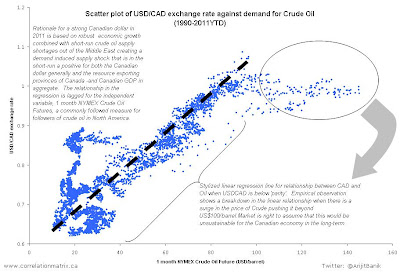
But we need some context. The point I am trying to make today is that the CAD-Oil relationship has always been thus: beyond $100 per barrel, the correlation of CAD to oil is non existent but beneath it, the relationship remains valid and should be an integral input to anyone's CAD outlook. As a picture is worth a thousand words, let's elucidate this discussion with some charts.

Exhibit 1 shows a time series of USDCAD against the 1 month future price of crude (January 1, 1990 - March 7, 2011)

Exhibit 1


Exhibit 2 is a scatter plot of USD/CAD against the price of crude with a stylized regression to show the relationship when crude is less than $100 per barrel and above $100 per barrel (where I argue that the relationship breaks down).
Exhibit 2
For the sake of a bit of rigour, here are the regression figures (Exhibit 3 & 4):
The relationship in the regression is lagged for the independent variable, 1 month NYMEX Crude Oil Futures, a commonly followed measure for followers of crude oil in North America.

Exhibit 3: When Oil <= 100/barrel


Exhibit 4
: When Oil > 100/barrel


To add some nuance, here are the regressions since 2000.


Exhibit 5:
A stronger CAD - Oil relationship.


Takeaway for CAD for the remainder of 2011.
Over the past fortnight, we have witnessed tensions in the Middle East erupt with a long overdue exercising of democracy in Tunisia and Egypt, and the attempted ousting of a despot, Mohammar Quadaffi, and the subsequent entrenchment of civil war in Libya. Naturally, this has meant uncertainty in the flow of Libya’s sweet crude to Europe hence the spike in North Sea Brent. WTI, the North American benchmark, has decoupled from Brent but has not been immune to speculation this has meant a strengthening CAD in the past and is witness today of CAD highs against USD last seen in 2007.

Rationale for a strong Canadian dollar for the remainder of 2011 is based on robust economic growth in the domestic economy the Bank of Canada is counting on GDP growth to come from business investment and a closing of the output gap by the end of 2012 combined with short-run crude oil supply shortages out of the Middle East creating a demand induced supply shock that is in the short-run a positive for both the Canadian dollar generally and the resource exporting provinces of Canada and Canadian GDP in aggregate.

Trees don’t grow to the sky and neither can CAD.
As shown in Exhibits 3-5 when Oil has exceeded USD 100/barrel the relationship breaks down.

Is CAD strength a drag on non resource exports? I believe so. This could be due to greater demand elasticity for manufactured goods; the idea of higher resource costs acting as a tax and reducing consumption in the U.S. when Americans confront $4 a gallon gasoline. Moreover, a persistently stronger CAD makes Canada’s exports uncompetitive which is untenable given the country's long running productivity challenges. But these inputs work their way through to the macroeconomic numbers with a lag. The entry of 2 billion consumers and their demand for the spoils of Western style consumerism dispersed amongst the BRICs simply complicate matters.

FX cannot be seen exclusively through the prism of an an equilibrium value as strict disciples of neo-classical economics are wont to do, hence their advocacy of a random walk any forecast of a currency pair must take into account short, medium and long term factors. In relation to USD, those short and medium term factors weigh heavily in CAD's favour.

USD remains a safe haven and is viewed as such when the risk off (risk aversion) trade is in favour but… all signs point toward USD weakness in 2011:


  • real long term interest rate differentials;

  • risk appetite;

  • trend following;

  • current account deficits;

  • ability to reduce FED balance sheet to ward off nascent inflationary pressures;

  • a viable and realistic fiscal plan;

  • budget challenges at the state and municipal level are negative to USD.
    If the United States were any other country then there would have been a massive USD devaluation by now; the strong dollar policy is a convenient fiction and accusing China of currency manipulation however warranted
    won’t make America’s fiscal challenge disappear.

Saturday, January 15, 2011

Monnet's Legacy, Europe's Nightmare

1943
"The countries of Europe are not strong enough individually to be able to guarantee prosperity and social development for their peoples. The States of Europe must therefore form a federation or a European entity that would make them into a common economic unit.”

Jean Monnet, Chief Architect of European Unity, addressing the National Liberation Committee in Algiers.
1991
"Europe is an economic giant, a political dwarf, and, even worse, a worm until it concerns itself with elaborating a defence capability."

Mark Eskyns' (then Belgium's Foreign Minister) frustration concerning the European Union's ("EU's") lack of responsiveness during the First Persian Gulf War.

2010

"I trust that the ESRB (European Systemic Risk Board) will introduce a new policy function at the EU level with great potential for enhancing the ability of European and national authorities to safeguard the stability of the EU financial system as a whole."

Jean-Claude Trichet, ECB President, at the Quarterly Hearing before the Committee on Economic and Monetary Affairs of the European Parliament amid the sovereign debt crises befalling the Eurozone's peripheral nations, Portugal, Ireland, Italy, Greece and Spain (referred to pejoratively as the "PIIGS").

2011


"This moment is a turning point for Emu, and for the future of Europe. Most observers point to the high risks – which cannot be denied."

Otmar Issing, president of the Centre for Financial Studies and a former member of the ECB's executive board, writing in the Financial Times (Feb. 15, 2011) that "Europe cannot afford to save Greece."

Where does Europe -- and for the sake of brevity Europe refers nominally to European monetary union ("Emu" aka the "Euro zone") -- go from here? Euro skeptics have warned that the idea of a single European currency was at best a fanciful experiment in idealism and at worst doomed for failure amongst a people -- Europeans -- who could not agree on anything, let alone questions such as:
  • who are the greatest European leaders, thinkers, and artists?

  • what are the most important ideas emanating from the continent?

  • which are the significant monuments exemplifying European identity?
Surely there would be a short-list of answers forthcoming to all but the most casual and vacuous observers who live on a diet of thoughtless reality television? No -- for the real-life experiment that is the Eurozone, and the disconnected bureaucrats in Brussels who are its modern architects -- these are seemingly insurmountable questions that have no readily available answers. The designs on Euro banknotes are a manifestation of this predicament and symbolic of Europe's monetary union fallacy:
Owing to the ubiquity of countless historic bridges, arches, and gateways throughout the continent, all the structures represented on the banknotes are entirely fictional syntheses of the relevant architectural styles, merely designed to evoke the landmarks within the EU.
From Jean Monnet's exhortation for a united Europe to Otmar Issing's warning of moral hazard in the bailouts of profligate states, the idea of a Europe united has been laudable but the concept of monetary union within that framework has been flawed: history will judge it to be an experiment in the audacity of hope over pragmatism which happily put the political cart before the economic horse.[1]
It is precisely economics and not an over-riding political philosophy of a greater "United States of Europe" that attracted individual nation states to clamor for entry into the old EEC (European Economic Community).[2]
However, the current EU has four times the membership of the original EEC -- Estonia joined earlier this year and is one of the many Eastern European members that are interested in market access rather than a the supra-nationalism proposed by the Western European elites.
Nationalism lives: Europeans identify their nation state as the focus of their allegiance and under the EU structure, the European Parliament's powers remain limited but growing in the aftermath of the global financial crisis. Moreover, the average citizen is disconnected to the policies and rhetoric emanating from the European elites -- consider the abject failure in ratifying the European Constitution -- who are bent upon strengthening integration.
The currency crisis befalling the euro will not stop -- the common currency remains significantly overvalued. The solutions proposed to provide assurance to financial markets are nothing but modern day political legerdemain masquerading as financial panacea -- the European Financial Stability Facility (EFSF) comes immediately to mind -- and the strengthening of the euro as a result of ECB President Trichet's posturing and forewarning about the central bank's intention to aggressively tackle possible inflation are nothing but short-term band aids to a chronic predicament.
Europe's leaders have let down their citizens: they have not had the will in the past to put their fiscal houses in order and now as card carrying members of a neo-liberal globalized economic system where capital flows reign supreme in search for the highest return at the lowest cost, they are wholly incapable of restructuring for the future in an honest manner.
The citizens of Eurozone member states in particular will wake up eventually to a new reality: one where the current and next working generation must toil significantly harder than the generation that is currently on the throes of retiring albeit with reduced benefits; they will do more for less. And, to complicate matters, the peripheral nations states either requiring or being forced to take economic assistance courtesy of EU-IMF pressure will lose their sovereignty. The Irish understand this already; look for the new Irish government to restructure the terms of Ireland's financial sector bailout and for more selling pressure against the euro this spring.

This entry focused on the political folly of monetary union within the EU -- an exercise in hubris by the integrationists in Brussels -- and the contention that nation states (particularly the junior or more indebted members) must give up sovereignty in order to remain long term EU members. The future solutions -- ignoring outright default -- will be done on the backs of the working people who have little knowledge of policy and utter ignorance in terms of the costs of their entitlements to their government's fiscal positions which are now beholden to capital flows.

The next entry shall focus on the idea of monetary union in general and why conventional wisdom during one period does not necessarily hold when viewed through history's monocle.

[1] Paul Wilkinson has written lucidly on this:"...Political motivation for developing economic integration was the belief that if you could integrate certain key sectors of the economy across national borders you would be able to reduce the war potential of states. The creation of the European Coal and Steel Community (ECSC) in 1951 was a major catalyst in the integration process." International Relations - A Brief Insight, p 199
[2] Recall that the United Kingdom, Ireland and Denmark joined in 1973; Greece in 1981; Portugal and Spain in 1986. The thrust behind every applicant was economic not political.

Sunday, October 31, 2010

Age of Empires (Part 2 of 2): Waning towards a fiscal straitjacket

The first part of this post centred on the notion of America as an empire, and how it differed from the prototypes of empires past. It concluded by mentioning briefly the role of financial statecraft -- the use of policies that influence financial flows to achieve both economic and traditional foreign policy goals. This should be expanded upon.

The United States has been home to the world's most influential and connected investment banks and financial institutions. To this day, these Wall St. firms are a magnet for talent and -- due to New York being the world's financial capital -- sources of access to capital, originators of financial engineering, and catalysts in the art of the deal; the moral hazard inherent in the US bail out of the financial system has done nothing to change this perception. However, these titans are not what they once were. The reality is that US banking will be burdened with toxic loans for years to come (despite the Fed's forthcoming QE2 measures where the central bank will presumably consume more of the wreckage of the sub prime mess) and a more stringent regulatory environment. Moreover, it is tarnished with the resentment from "Main St." as a bastion of fat cats bankers who undeservedly received bail out money in the aftermath of The Great Recession.

This belies the idea that a weakened American financial system is not only bad news for mainstream Americans, who will not have access to credit to spur economic growth via small businesses, but also for military power and the ability for America to exercise foreign policy. In realist theory it is generally accepted that military power is the key requirement; this power is supplemented with wealth from industry and commerce which act as the key pipelines to acquiring the necessary military power. Logically, a weakened commercial sector, and by extension an anemic economic growth environment (which citizens in Western countries should be braced for in the coming decade due to debt ridden personal and government balance sheets), should entail a smaller flow of funds towards military expenditures. A fiscal crunch will come -- it is a matter of when not if and has been postponed thanks to the US dollar status as the reserve currency -- and this must mean eventual American disengagement (at least partially) in terms of its military reach. And this is despite the so-called "war on terror" that is believed to be just in the eyes of the neoconservative establishment, its loyal followers, and a percentage of the US population who live in perpetual fear of the "other".

Having said this, one must neither underestimate nor bet against the neoconservatives getting their way when it comes to America exercising muscular foreign policy; it may happen again after November 2 if the Republicans take control of the House (a probability) and the Senate (a possibility).

Taking the words (from Foreign Affairs, Jul. - Aug. 1996) of the Neocon movement's scion, William Kristol, publisher of The Weekly Standard and the best know of the conservative elites, it is his contention that America's rightful international role is that of a "benevolent global hegemon":
"Having defeated the "evil empire," the United States enjoys strategic and ideological predominance. The first objective of U.S. foreign policy should be to preserve and enhance that predominance by strengthening America's security, supporting its friends, advancing its interests, and standing up for its principles around the world." [1]

He goes on to state that the question of a threat is misconceived:

In a world in which peace and American security depend on American power and the will to use it, the main threat the United States faces now and in the future is its own weakness. American hegemony is the only reliable defense against a breakdown of peace and international order. The appropriate goal of American foreign policy, therefore, is to preserve that hegemony as far into the future as possible. To achieve this goal, the United States needs a neo-Reaganite foreign policy of military supremacy and moral confidence. [2]


Mr. Kristol exercised his substantial powers of persuasion during the eight years of George W. Bush's administration where America exercised deficit spending in order to go on its military excursions into Iraq and Afghanistan and exacerbated the fiscal situation by implementing the panacea of tax cuts on a willing public that had been fed the supply-side pablum of the Laffer curve.

But where does that leave America's foreign policy ambitions in the slow growth world post Great Recession world where confidence is low, middle America resentful, and structural unemployment much higher than reported and job growth lower than expected? They must be curtailed.

No doubt, the United States will remain dominant but its power, due to the realities of fiscal austerity that is being undertaken globally -- in small steps by many nations, in a giant leap by a few -- will wane as all levels of government hurtle head long towards a fiscal strait jacket.

The level of political discourse during the current U.S. mid-term elections has ranged from vacuous to barbaric; the world's most powerful nation remains in denial of the tough decisions it faces from entitlements to taxation to defence spending to health care.

The populist infused, billionaire -- think of the Koch brothers -- funded rhetoric of the grass roots Tea Party movement has done nothing to frame the conversation on a rational plateau. Notwithstanding the Pollyanna notion of tax cuts helping to balance budgets, one must be recognize that military expenditures will be cut and America's military reach will be curtailed lest America become a totalitarian military dictatorship -- a highly unlikely scenario even amongst the greatest pessimists
.

In the March/April 2008 issue of Foreign Policy, 3,400 active and retired officers at the highest levels of command were surveyed; when asked whether it was reasonable or unreasonable to expect the U.S. military to successfully wage another major war at this time, 80% of the officers said it was unreasonable. [3]

When asked about the U.S. military's preparation in terms of successfully fight a conflict in four hot spots (on a 1-10 scale with 1 being unprepared, 10 fully prepared), the results were: 4.9 for the Taiwan Strait; 4.7 for North Korea; 4.5 for Iran; and 5.1 for Syria. [4]

The Stockholm International Peace Research Institute (SIPRI), a global think tank, has done outstanding work on the military spending and armaments which has shown that America's expenditures in this regard have increased despite the economic downturn. [5]

Amid the deafening calls for fiscal austerity and the criticism of fiscal stimulus for an indebted nation, there must inevitably be a conversation about defence expenditure?

How long can this -- like America's addiction to foreign capital to fund its current accounts and budget deficits -- continue? Not indefinitely. While the sun did not set on the British Empire, Britain had to live within its means once its imperial ambitions outstripped its economic capacity.

It is vital to put a human cost to the neoconservative policies of benevolent hegemony. Consider the work of Linda J. Bilmes (who co-authored The Three Trillion Dollar War with Joseph Stiglitz) when she provided provided some preliminary figures in an essay that presaged her book:

Veterans who can no longer hold down a job, due to physical or mental injuries, are likely to qualify for Social Security disability compensation (adding another $22 billion to $38 billion to the bill). For others, the injuries they have suffered in Iraq and Afghanistan will eventually swell the rolls of Medicare, as the long-term effects of injuries and chronic illnesses appear.
Staggering though they are, these costs only represent the impact of the war on the U.S. federal budget. The many social and economic costs that the government does not pay, such as the loss to the economy of so many young, productive Americans and the costs paid by the state and local governments, communities, and private medical providers, could add another $415 billion to the total cost to the economy. Americans have so far focused only on the ballooning short-term price of the wars in Iraq and Afghanistan. but we have not yet counted the cost of caring for veterans, replenishing military equipment, and restoring the armed forces to their pre-war strength. This was will prove one of the costliest in U.S. history -- one whose bill we pass to the generations that follow.
[6]


Notes:

[1] William Kristol and Robert Kagan, "Toward a Neo Reaganite Foreign Policy," Foreign Affairs, Vol. 75, No. 4 (Jul. - Aug., 1996), p. 20 of pp. 18-32. http://www.jstor.org/stable/20047656
[2] Ibid, p. 23
[3] The U.S. Military Index, Foreign Policy, Mar. - Apr., 2008, p. 73 of pp. 71-77
[4] Ibid
[5]
http://www.sipri.org/
[6] Linda. J. Bilmes, "Iraq's 100-Year Mortgage," Foreign Policy, Mar. - Apr., 2008, p. 85 of pp. 84-85.


Monday, October 18, 2010

Age of Empires (Part 1 of 2): Can the US afford its imperial reach?

Most assume "no" to be the be the immediate answer but that would fail to explore the complexities of the American situation: in 'what' form is the empire, and 'why' exactly is it not sustainable? This post explores the former question; the next post the latter.
What type of empire?
The question of the United States as an empire is a fact of life to those on the left, contentious to many less interested in state actors, and an epithet to some sympathetic to the concept of benign hegemony. This post will attempt to steer clear of the pejorative; it is not concerned with whether America's reach is a positive force or exploitative --the literature on that is expansive-- but if it will lead to ask the question of whether the US can wield the same level of power in the future. First, let us consider some contrasting views of America as empire.


On the one hand, Joseph Nye --a former US Assistant Secretary of Defense and currently professor at Harvard's Kennedy School of Government-- who has travelled the lecture and book promotion circuit for the past decade promoting the the merits of "soft power" as a postscript to his noted scholarship on Power and Interdependence would forcefully disagree with the 'America as empire' notion.

On the other hand, Scottish historian and fellow Harvard professor, Niall Ferguson, has unabashedly described America's imperialistic credentials within the pages of Foreign Policy:
"During the course of the 2oth century, the United States occupied Panama for 74 years, the Philippines for 48, Palau for 47, Micronesia and the Marshall Islands for 39, Haiti for 19, and the Dominican Republic for 8. The formal postwar occupations of West Germany and Japan continued for, respectively, 10 and 7 years..."
While I neither dislike Nye's erudition nor lean politically as does Ferguson and do not subscribe to his penchant for historical revisionism --he is a member of Stanford's Hoover Institution, the well funded right wing think tank and advocates the contestable view of Britain's empire as the pioneer of free trade, free capital movements and free labour-- it is arguably Ferguson's articulation of America's reach as an empire which makes sense when framed against its military capability: a nation with more than 800 --by conservative estimates-- military bases globally, the American empire is not and has not been in the mould of traditional imperialism.
You have doubtless read of the the archetypes of empires past --be it the British, the Bolsheviks, the Romans, or the Romanovs; Anatol Lieven, an analyst at the New America Foundation think tank, has likened America to an indirect empire that resembles the Dutch in the East Indies during the 17th-18th centuries.

Since taking the reigns from a wounded Britain after The Great War and fully supplanting it by the time it entered World War 2 as the dominant economic and military force, America has unquestionably been an unprecedented global influence in a bipolar Cold War world and unipolar End of History morphing into Clash of Civilizations world.
The US penchant for self-interest has over-ridden any principled political doctrine at the foreign policy level from its executive branch: think of Woodrow Wilson's putative multi-lateralism that supposedly brought into the fold nation states of all stripes contrasted with his unabashed Dixiecrat racism; consider Henry Kissinger's amoral realism which favoured American support of despotic acolytes in favour of democratically elected regimes which did not fit with US interests--to this day polemicists like Christopher Hitchens characterize Kissinger as a war criminal; or remind yourself of Bill Clinton's naive idealism that bumbled along in permitting the Rwandan genocide (as described in Samantha "Hillary is a monster" Power's A Problem from Hell: America in the Age of Genocide). Every American originated doctrine, from Monrow to Truman to Bush evokes (in some form) Jesus of Nazareth's Sermon on the Mount in positing the idea of American exceptionalism.

Paul Wilkinson, Professor of International Relations at St. Andrews, in describing the US importantly references the United States economic (in addition to its combat) might:
"It also has the largest inventory of nuclear weapons and the most advanced high-tech weaponry in the world. America's superpower status depends on this vital continuation of huge economic strength and incredibly high levels of military expenditure, only made possible by America's unique wealth. [Moreover...] the US has a unique capability for the rapid deployment of its forces deploying both airlift and sea lift assets with remarkable speed."


However, it is through Martijn Koninjs's work on institutions that we can consider how the tentacles of US power are also rooted in the structure of global finance; in the wake of 2008's Financial Crisis, the adage of "Too Big to Fail" spawned books and become part of the vernacular in policy circles. Yet "Too Big to Fail" fails to reflect that it is the interconnectedness of financial institutions and the network effects of negative feedbacks that have resulted in credit, the grease of global commerce, drying up, and the financial system coming to a halt. It is the nature of capital to bypass obstacles and pursue the highest return; and this is done through the financial engineering of American financial institutions hence the proposition of "Too Connected to Fail" remains the greater danger.

Indeed, size is important but understand that while China's state owned banks are now the world's largest, a failure of a Chinese financial institution at this time will have comparatively less effect on most developed nations (save for Australia) than a failure of a significantly smaller American investment bank --such is the nature of America's empire--because when America sneezes, the rest of the world truly does catch a cold.

Notwithstanding the meaningless rhetoric of 'less government' during the current US mid-term elections, it is important to consider the role that the American state played in the expansion of international financial markets and the reliance of American intermediaries as the primary conduit of global capital. The American financial system, has been a key factor in perpetuating American empire: financial statecraft has become an essential pillar of strength. It is wounded, and the fiscal situation makes America more vulnerable: it is down on the matt but is it out for the count?

Monday, September 27, 2010

Commonwealth Games 2010: Choices after the circus is over

The road forward?

There is no easy path forward, no prescriptive panacea to rid the nation's of its deficiencies; uneven development is not simply the fault of the ruling class --undoubtedly, individual responsibility plays a role-- but they must be retrospective in what has worked and what has not in proposing a feasible future so that reality can match hyperbole in terms of the country's future.

Education

When Jawarharlal Nehru, India's first Prime Minister, evoked the nation's "tryst with destiny" he subsequently embarked on creating world class tertiary education at the expense of sound primary and secondary systems. The result was a never ending brain drain since 1947 and to date, 35% of the population remain illiterate while some 15% of Indian students reach high school, and 7% graduate.

There are those who criticize the great unwashed and complain of the indigence and indolence of India's teeming masses, but surely, this is short-sighted? Is it not the ignorance of the underclass who have received either poor or non-existent schooling in the vital formative years that is of greater concern? Ignorance begets ignorance for when a proper education is not received, it is not valued.

The collapsed pedestrian bridge provides the visual metaphor: it looked good when it was completed but it did not have the foundation to sustain the stream of people who would cross it --akin to the skilled citizenry required to move a post-industrial society forward?-- and, as such, it broke apart when under stress and must be re-built properly anew with the proper foundation and care.

Development

Using China's mercantilist template as a development model is not the answer for India. One cannot argue with the leaders in Beijing and their ability to manage top-down for their form of mercantilism works at the macro level: China's massive foreign exchange reserve growth is a reflection of an undervalued exchange rate, loan subsidies to its export champions and import restrictions to protect its nascent industries. But if it cannot continue without serious American political backlash in the aftermath of the Great Recession of 2008-09.

The liquidity resulting from China's reserves has been funneled into in a real assets-- we see this in the real estate bubble which will implode one day; unarguably, China is infrastructure ready and has built a world class project management culture --by evidence of the Beijing Olympics, the Shanghai skyline and the myriad "special economic zones" and open coastal cities-- but the continuing sterilization of its monetary reserves cannot go on without ensuing intervention from other countries. In a zero-sum framework of global economic growth, China is screwing its biggest customer by not permitting it to adjust to the disequilibrium in its economy.

In addition, the People's Party Manadarins will face the task of providing a safety net for the citizens. China's economic miracle has been made possible by the tireless toil and sacrifice of its migrant worker; these struggles have been skillfully shown in Fan Xiling's documentary Last Train Home. How long can they be expected to keep going, especially if the target markets fully de-leverage, consumption recedes and the production from the world's factory is no longer required?

Society

Whether one subscribes to the classical liberal view of Peter Bauer or is an adherent to the welfare analysis of Amartya Sen; whether one prefers Paul Collier's top down approach or William Easterly's bottom up focus to economic development, one would have to be in complete denial that economic liberalization has been beneficial to many, specifically the aforementioned middle class in urban centres.

However, most in the country remain desperately poor and are in a worse state of affairs despite liberalization; they have been left off the growth track and in the zeal to placate a corporatist model of development, there has been (in the words of David Harvey) an accumulation by dispossession template followed in rural India which has not benefited society's underclass. The Maoist rebellions in India will not magically go away. Current Indian Prime Minister, Manmohan Singh belatedly admitted:

"We cannot overlook the fact that many areas in which such extremism flourishesare under-developed and many of the people, mainly poor tribals, who live in theseareas have not shared equitably the fruits of development. It isincumbent upon us to ensure that no area of our country is denied the benefitsof our ambitious developmental programmes ."

This is a positive step yet the fear is that the focus will continue to be on the terrorist activities of the Maoist rebels rather than on the narrative, which Sudeep Chakravarti, author of Red Sun: Travels in Naxalite Country, argues should be focused on the failings of the nation, where the disconnect between urban and rural India on matters political, economic and social has given rise to the manifestation of extreme-Left wing movements amongst the rural poor.

The reaction from India's media has centered on shame and excuses but some good can come out of the Commonwealth Games fiasco: here are two thoughts that are worth noting from two different worlds: business and humanities.
The first, again from Harvard Business School’s Michael Porter, on the behaviour required of its political and business elites:
“India needs to learn to be more self-critical, more open, and much more honest about what needs to be done.”

The second from Quentin Skinner, Professor of the Humanities at Queen Mary, University of London, citing Cicero in describing the values that potential leaders require is aimed squarely at the country's political class:
“a willingness to subordinate our private interests to the public good; a desire to fight against corruption and tyranny; and an ambition to reach out for the noblest goals of all, those of honour and glory for our country as well as for ourselves”