Friday, July 19, 2013

Quantitative Easing: Monetary Policy as Reflation with the Confidence Fairy

Here is a video: "John Kay on the Mystery of QE" from FT.com

In the modern financial economy, the main effect of QE is to boost asset prices, as market gyrations of recent weeks have clearly illustrated. But is the pursuit of higher asset prices an effective or desirable means of promoting economic growth? The distributional impact of the policy demands attention; the one certain consequence of boosting asset prices is that those with assets benefit relative to those without. Many people own houses – but, although in the UK, for example, we need more houses, we do not need another housing boom. The public also holds financial assets indirectly, largely through pension funds. But here there has been a paradoxical effect: because of the way pension funds are valued, QE has generally increased pension funds’ liabilities more than their assets.
For the full commentary you can go to John Kay's website (click here)

The last sentence was a massive understatement from John Kay. See charts below for Canada and more so the United States which has embraced zero interest rate policy along with the Federal Reserve's own brand of quantitative easing. Growth in liabilities continues to outpace growth in assets leading to more DB (defined benefit) plans being underfunded. At the extreme, it may be the death knell for many if plan sponsors continue to cling to the belief that asset returns will mean revert to those seen during the bull market of the 1980s and 1990s along with a corresponding pop in nominal interest rates. As yours truly has asked many an investment consultant and actuary: "what about the Japan scenario? what then?"


Canadian Pension Funding: Cumulative Returns - Assets vs. Liabilities (2006 - 2013 YTD)
Source for Canadian Data: BlackRock

U.S. Pension Funding: Cumulative Returns - Assets vs. Liabilities (2000 - 2013 YTD)
Source for U.S. Data: Ryan ALM

U.S. Pension Funding: 12 Month Rolling Returns: Assets vs. Liabilities (2000 - 2013 YTD)
Kay concludes:
Why has so much attention been given to these monetary policies with no clear explanation of how they might be expected to work and little evidence of effectiveness? The very phrase “quantitative easing” seems designed to discourage non-technical discussion. But the real answer, I fear, is all too familiar: these policies may not benefit the non-financial economy much, but they are helpful to the financial services sector and those who work in it.


Comment:
By now it should be clear that the incarnations of QE as executed by the FED, BOE, and ECB have not been as helpful as originally advertised. There is the old yarn spun by economists about lags in policy being long and variable: this has never been more true than in the case of QE where the lag has been longer than expected with the consequence of asset reflation rather than capital investment to grow the productive capacity of an economy.

The line of thinking from establishment circles places great emphasis on managing expectations and decreasing policy uncertainty. This is a canard. All actors in an economy live by heuristics, sometimes less rationally than others, but always with an implicit understanding that --with a bit of luck and a lot of hard work-- there should be a light at the end of the tunnel. It is this hope that drives capitalism and running the rat race on a knife edge that keeps people going; the finely worded proclamations of Chairman Bernanke, Governor Carney, President Draghi which are so closely watched, read and parsed by financial market actors are completely lost on the common person trying to make ends meet.

If QE is to work as a useful policy tool that ideally it should have the explicit goal of expanding credit creation in the productive economy --not providing more mortgage financing for real estate speculation. The banking sector plays a massive role in this regard and whether concepts of narrower banking and more localized banking are realistic or not will be the decision of national policy makers and regulators. One thing is unequivocal: a return to the 4 C's of credit --character, capacity, capital, collateral-- with a nod to the fifth C (conditions) is necessary to fund the business sector in general and SMEs in particular. This entails a less profitable banking sector but, perversely, a more productive, more dynamic and healthier economy than we have now.


References:
Kay, J. Financial Times, "Quantitative easing and the curious case of the leaky bucket." Last modified July 10, 2013. Accessed July 19, 2013. http://www.johnkay.com/2013/07/10/quantitative-easing-and-the-curious-case-of-the-leaky-bucket.

Thursday, July 4, 2013

Matheus Grasselli in conversation with Marshall Auerback: How Advanced Mathematics Can Support New Economic Thinking


This video is about 16 minutes long and features mathematician Matheus Graselli in conversation with Marshall Auerback. Currently the DSGE paradigm is considered state of the state of the art in terms of forecasting tools for central banks. The IS-LM model of Sir John Hicks remains a pedagogical tool for intermediate macroeconomics while the heterodox models of Hyman Minsky and Wynne Godley are beginning to gain traction amongst quantitatively inclined forecasters interested in non orthodox (i.e. not 'neoclassical') approaches. Other fields -- engineering comes to mind immediately -- tend to see systems as not being inherently stable and consider robustness as a critical component to systems design. The economy, by contrast, while immeasurably more complex than say a process in a chemical plant, is assumed to mean reverts and go back towards an ostensibly stable equilibrium path. The recovery, or lack of it, post 2008 illustrates the vacuity of this approach. The Fields Institute in Toronto, along with George Soros' Institute for New Economic Thinking ("INET") is looking to  remedy this approach and it is critical that they succeed. Go here to see details on Mathematics for New Economic Thinking - An INET workshop to be held October 31 - November 2, 2013.

FORMAT

This will be a 3-day workshop with each day comprising of 5 to 6 invited talks followed by round table discussions on an emerging area in new economic thinking.
Topics include: financial instability, default contagion in the banking system, the role of shadow banking, macro-prudential regulation, credit and leverage cycles, liquidity, fiscal sustainability, debt and deficits, monetary policy implementation, central banks as lenders of last resort, sovereign default contagion, stock-flow consistent models, dynamical systems models in macroeconomics, agent-based economics, gauge theory and preferences, the consequences of the SMD theorems, money in modern economies, radical uncertainty, long-term growth and sustainability

Monday, June 17, 2013

Have Canadian Households Embraced Riskier Activity by Choice or Necessity?

On June 13 the Bank of Canada ("BOC") released its bi-annual Financial System Review ("FSR") which can be downloaded from this site. In contrast to the central bank's quarterly Monetary Policy Report which always concludes with "Risks to the Outlook" that are, by bank policy, "roughly balanced over the projection  horizon" the FSR explicitly states downside risks. In the most recent release those risks were articulated as follows:
Nevertheless, the Canadian financial system continues to be vulnerable to a number of key risks. These risks are similar to those highlighted in the December FSR and emanate primarily from the external environment: sovereign and banking stresses in the euro area; deficient global demand; elevated household indebtedness and imbalances in some segments of the Canadian housing market; and increased risk taking arising from a prolonged period of low interest rates. [emphasis added] 

In addition to the Risk Assessment section the FSR contains three reports: The Basel III Liquidity Standards: An Update; The Market for Collateral: The Potential Impact of Financial Regulation; Monitoring and Assessing Risks in Canada's Shadow Banking Sector. The latter is summarized by Maclean's columnist Erica Alini in her piece, "The shadow banking sector has been feasting on government-insured mortgages"
These are all worth a read but predictably the media singled out the BOC's concern about household debt. For example here (Quinn June 14, 2013) states:
Household debt reached a record 165 percent of disposable income in the fourth quarter, and Finance Minister Jim Flaherty tightened mortgage rules last year to avoid what he called signs of overheated condominium markets in Toronto and Vancouver. Statistics Canada will publish first-quarter debt figures later this month. The central bank forecast today that the debt to disposable income ratio will stabilize this year. Other signs of “constructive evolution” of household imbalances include slowing housing starts and resales since mid-2012, according to the report.
 Here is the now infamous chart of how Canadian household debt has marched upwards since 1990:

Looking at a shorter time span (2005-2013YTD) the BOC has observed levelling off of house prices:


Yet that house price to disposable income ratio remains significantly higher than the average level (1981-present) in Canada:

The Economist newspaper uses a different measure (Prices against average income) but shows a similar story comparing Canada vs. United States during the period 2002-2013YTD


Extending this time series out to 20 years here are Prices against average income (Canada vs. United States) 1992-2013YTD


Now going back another 10 years there is a generation of Prices against average income (Canada vs. United States) 1982-2013YTD


The immediate takeaway from this is that in aggregate the cost of home ownership for Canadians has been higher for a generation when compared to their neighbours south of the 49th parallel. When one considers that the cost of capital is also higher in Canada, mortgage interest deductability is absent save for the precious few willing to financially engineer it by methods like the Smith Manoeuvre and its derivatives, and long term mortgage rate terms (i.e. above 5 years) are a rarity for Canadian consumers, it should be pause for thought for those looking at such a measure (be it 'prices/average income' or 'household debt/disposable income') as a meaningful comparison with the American experience to be a predictor of a possible inflection point and future downturn. 
The Canadian financial system weathered the global financial crisis better than most other systems due to the oversight of its financial regulators (OSFI), the relatively conservative nature of its banking oligopoly, and a critical behavioural aspect: the steadfast resolution of Canadian consumers to meet and not renege on their debt obligations.

Is the latter a result of Canadian bankers better adhering to the 4 Cs of credit --character, capacity, collateral and capital-- before sending off mortgage and loan applications for approval? That is possible but unlikely. The front line of any financial institution, from the office of a local bank branch to the sales desk in capital markets (broker/dealer) is a main point of entry for risk into a diversified money center bank's balance sheet. There   are enormous pressures on individuals to sell as many products (to the end consumer) as possible and do so within the parameters of a standardized risk-reward trade-off that would not require extra oversight from risk management. Essentially, the more that the process can work like a smooth functioning assembly line the better for any wrench in the cog would slow down the revenue stream. To wit, the bigger the mortgage that can be approved the better. Such opportunities have grown since the early 1980s: the importance of finance and concomitant financialization of the economy has seen steadily increasing debt loads in the household sector whose wage growth has been moribund. As (Palley 2007) states:
The financialization thesis is that these changes in macroeconomic patterns and income distribution are significantly attributable to financial sector developments. Those developments have relaxed constraints on access to finance and increased the influence of the financial sector over the non-financial sector. For households this has enabled greatly increased borrowing.  [emphasis added]    
Typically, the concept of home ownership has often been framed in terms of being an Anglo-Saxon phenomenon --with North America and Britain at one end of the spectrum and Europe at the other. Yet when we look at core European countries we observe that Canadian 'affordability' is greater than that of either Belgium or The Netherlands which is experiencing the start of a serious downturn at the moment.
Prices against average income (Belgium vs. Canada vs. Netherlands vs. United States) 1982-2013YTD

There are always multiple dynamics at play and each nation's case needs to be considered on its own merit. Coming back to Canada, my colleague David Wishart (visit his blog, The Dismal Science here) made the astute observation of household debt accelerating in Canada after 2003 after increasing steadily in lock step with nominal GDP from 1981-2003. His words below:

Things started going wrong in 2003. What changed? CMHC removed the price ceiling on the mortgage amount it would insure. The Blue line represents how much debt the total amount of employed labour is carrying, which is a better indicator than household debt per capita because these are the actual people servicing the debt. As of 2011 it was at $130,000, so for a couple that's $260,000 which is 3.39 times after tax household income. In 2003 this ratio stood at 2.33 times. That's an increase of 5% yoy, which is greater than GDP growth, suggesting it's not sustainable, which the current slowdown in housing is making evident. [emphasis added]


Something unwritten in the media is the concept of debt being made available to consumers. It is usually framed solely as lower rates after the great financial crisis encouraging riskier activity: this is what the Bank of Canada writes, and it is what the much of the media parrots but it isn't necessarily accurate.

Going back across the pond to the Emerald Isle we can see what happens when House Prices outpace Wage Growth:


Michael Taft, on his blog, Unite's Notes On The Front, articulates it as such:
First, household debt did not become a crisis because people ‘went nuts’ buying houses without any regard to anything. It was a systemic crisis – deeply rooted in the base of the political economy. Faced with this systemic phenomenon people had two choices when purchasing shelter. They could either take on a lot of debt buying a house, or they could travel far away from work to buy a house they could afford (adding transport costs and losing home-time for their efforts). People’s behaviour did not cause the property boom, it was merely a response. They did not and could not control the price of housing – that was driven by a runaway market manipulated by a golden circle of myriad interests. 
And there were no substitution goods. Renting in the private sector was not an option for most household types as this sector was woefully under-developed.

Second, the household debt crisis did not arise through the normal functioning of the ‘market’. As we saw above, house price increases were consistent with average wages and construction costs in the period between 1990 and 1996. Builders weren’t losing money during this period. They weren’t building and selling houses for philanthropic reasons. They were making profits and employing workers. But the speculative gap arose because the normal functioning of the market was perverted. How do you think financial institutions make a living? They earned profits by loading households with debt. A number of interests made a lot of money with the complicity of Government policy (tax reliefs, tax cuts, lax planning regulations, boom-incentivising development fees for local authorities, etc.) and irresponsible financial regulation.

The household debt crisis is a political and social issue. It is not – and let’s be absolutely clear – it is not an issue of individual profligacy or household irresponsibility. That people get into financial trouble through imprudent conduct happens all the time – but to suggest that that the property crisis was simply the aggregation of individual financial recklessness is merely a self-serving attempt to shift blame. [emphasis added]
This fits well into the Canadian context -especially when one considers that rate at which residential real estate costs have skyrocketed past the rise in incomes. As has been noted before in this blog, deleveraging in Canada is inevitable. The yet to be determined end game is whether it will come in a smooth or turbulent fashion. The bet here is for the former as households will be forced to hold back on consumption in order to service an increasingly large stock of debt.

References:
Financial System Review (2013): p.1, http://www.bankofcanada.ca/wp-content/uploads/2013/06/fsr-0613.pdf (accessed June 16, 2013).
Alini, E. "The shadow banking sector has been feasting on government-insured mortgages." Maclean's, June 14, 2013. http://www2.macleans.ca/2013/06/14/the-shadow-banking-sector-has-been-feasting-on-government-insured-mortgages-bank-of-canada/ (accessed June 16, 2013).
Quinn, G. Bloomberg, "Bank of Canada Says Household Imbalances Will Be Slow to Correct." Last modified June 14, 2013. Accessed June 16, 2013. http://www.bloomberg.com/news/2013-06-13/bank-of-canada-says-household-imbalances-will-be-slow-to-correct.html.
Palley, T. Financialization: What It Is and Why It Matters*. working paper., The Levy Economics Institute and Economics for Democratic and Open Societies, 2007. http://www.levyinstitute.org/pubs/wp_525.pdf
 Taft, M. Research Officer, UNITE the Union, "Unite's Notes On The Front." Last modified June 13, 2013. Accessed June 13, 2013. http://notesonthefront.typepad.com/politicaleconomy/2013/06/the-hulk-says-crush-household-debt.html.

Wednesday, June 12, 2013

Reasoning about Rationality: Why Bubbles are both Banal and Necessary ~ William Janeway

What follows is the link to William Janeway's lecture at the Field's Institute in November 2012: Reasoning about Rationality: Why Bubbles are both Banal and Necessary
The introduction is by Matheus Grasselli. Those interested in the slides, they can be downloaded here. The lecture is about 50 minutes in length followed by a 20 minute Q and A. For those interested in reconciling the innovation process amid conventional wisdom that evokes rationality and efficiency at every turn, this is the next best thing to reading his book, Doing Capitalism in the Innovation Economy: Markets, Speculation and the State.

If there is anything to take away from the lecture it is Janeway's belief, backed up by forty years as a successful capitalist in general and influential venture capitalist in particular, that bubbles are endogenous to financial capitalism; bubbles always burst; and bubbles can be focused on anything from tulips to real estate to information and communication technologies ('ICT') --some of which are productive, others not.

When the occasion arrives that the focus of a bubble is a fundamental new technology then there will be associated bubbles in the build out of that network and the search for what to do with that network. In the current context think about the advent of ICT in the early 1980s begetting the tech boom of the 1990s begetting the dot come mania of the late 90s which in turn have found capital looking for opportunities in areas ranging from social media, to big data and 3D computing in the 2010s. The latency of technological development repeats throughout history. It is arguably getting shorter but the uptake of green technologies appears to bear out the traditional view.

There is a wonkish flavour to the lecture where Janeway dissects tenets of neoclassical finance theory by going over much of the literature. Some of the papers he cites can be found here on Graselli's course page for Asset price bubbles: economics, mathematics and statistics. It should be noted that while Janeway earned a PhD in economics from Cambridge University under the supervision of Richard Kahn, he did not pursue academia as a vocation. He saw the writing on the wall whereby what he had learned at Cambridge would not be welcomed within the hallowed halls of tertiary learning in America --already so immersed and enamored was U.S. establishment with marginalism and Walrasian equilibrium where money is just a veil over barter. In a recent speech (Janeway October 11, 2012) he stated: 
In 1971, I left Cambridge University with a doctorate in Economics and an extraordinary intellectual endowment. Supervised by Richard Kahn, I had passed four years immersed in the economics of Keynes – not, that is to say, Keynesian Economics. This meant recognition, first, of the integration of economics and finance at every level, from the most micro scale of the individual consumer, entrepreneur and – especially – investor to the aggregate scale of the macroeconomy. Second, it carried with it a profound skepticism with respect to the notion of efficient markets and the promise of stable equilibrium. Third, it meant recognition of the inescapable ontological uncertainty under which economic and financial decisions are made. In consequence, I found that I could not teach Samuelson’s Neoclassical Synthesis, which what was on offer in the Departments of Economics across America. [emphasis added]
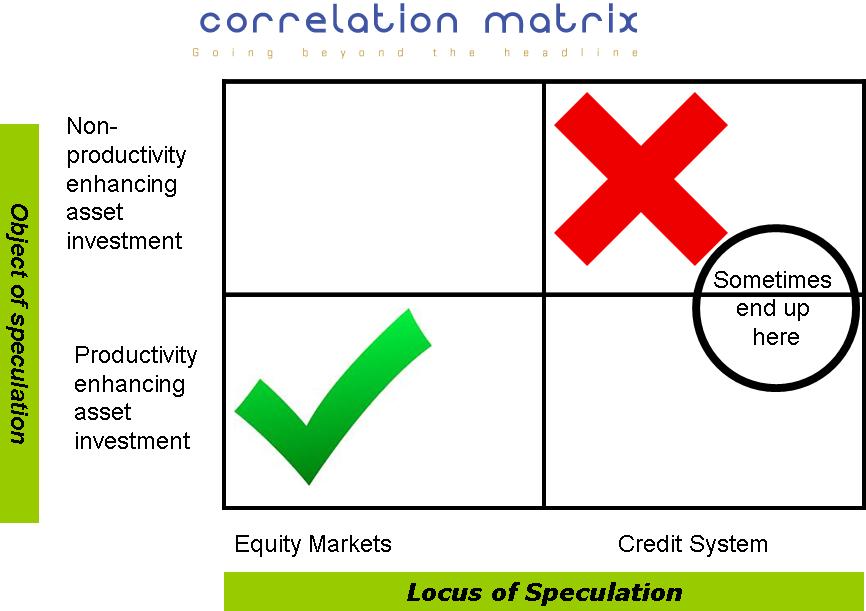
To sum up Janeway's lecture in a 2 x 2 matrix (below), it is that while bubbles always burst, those that burst in the equity market do relatively little harm compared to those in the credit markets as the latter compromise the banking system and paralyze the real economy.

Now, the idea that bubbles in the equity market do relatively little harm has less weight in the modern context when the social contract has been whittled away and people are forced to take on market risk for the sake of their own future retirement income (think of DC plans replacing DB plans). However, the general thrust of his argument remains valid: when the locus of speculation interests with the object of speculation in the top right quadrant (focusing on non-productivity enhancing asset investment) then a bursting is far more harmful than if a bursting were to occur in the bottom left quadrant (focusing on equity market funds going into productivity enhancing assets). In Janeway's way of thinking, there are necessarily one hundred pets.com busts for every amazon.com gem. 

Summarizing Janeway's lecture in a 2 x 2 matrix


References:
Janeway, . LSE public Lecture, "What I learned by Doing Capitalism." Last modified October 11, 2012. Accessed June 12, 2013. http://www2.lse.ac.uk/publicEvents/pdf/2012_MT/20121011-Janeway-Transcript.pdf.